


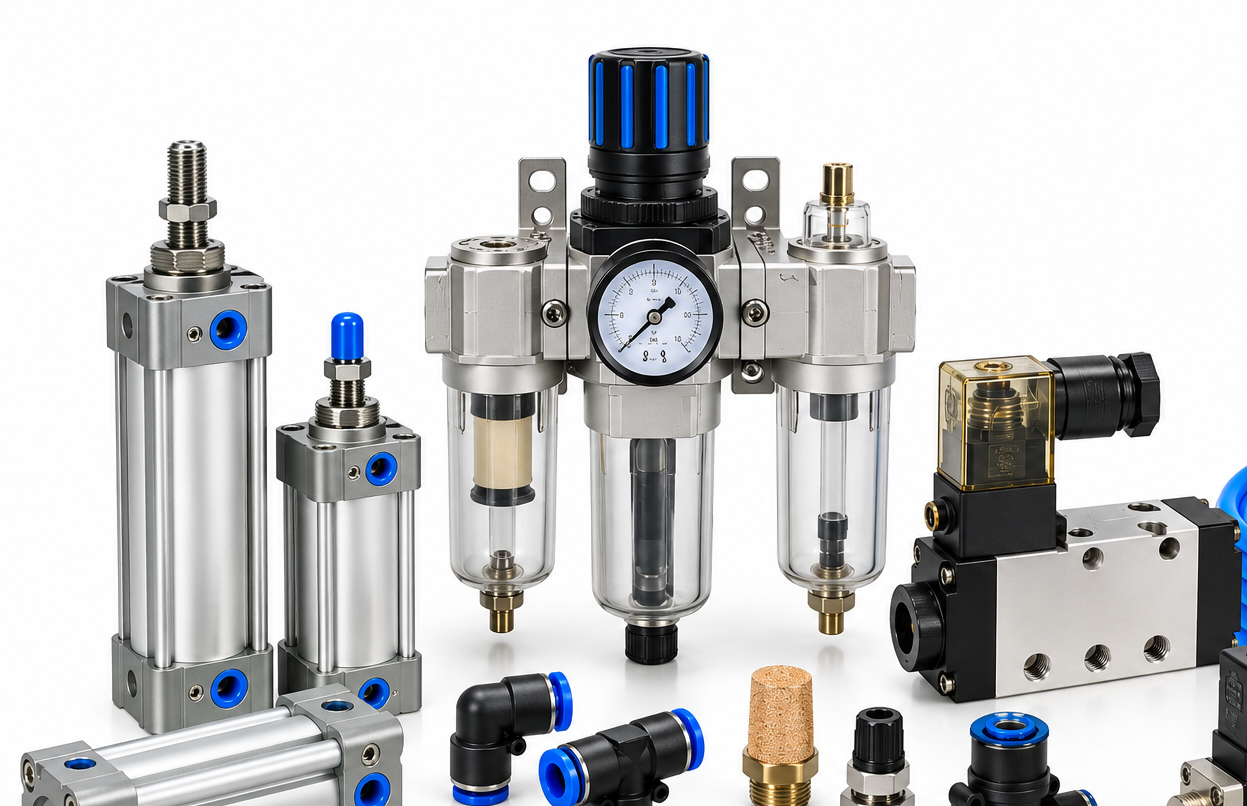
Compressed air is used across manufacturing plants for operating pneumatic tools, cylinders, actuators, packaging machines, assembly equipment, cleaning systems, automation equipment, and production machinery. When the pneumatic network is poorly planned, even a capable compressor may struggle to deliver stable performance at the point of use.
For industrial facilities in Ghaziabad, understanding how Spack Pneumatics components fit into a compressed air system can help maintenance teams make better equipment decisions.
Understanding the Role of Pneumatic Components
A compressed air installation is more than an air compressor. Air must travel from the compressor to individual machines while maintaining suitable pressure, cleanliness, and flow.
Depending on the application, a pneumatic system may include:
- Air preparation units
- Filters
- Regulators
- Lubricators
- Pneumatic valves
- Cylinders
- Connectors
- Tubing
- Pressure-control components
- Air distribution accessories
Each component influences how efficiently compressed air reaches the equipment it serves.
Why Air Preparation Matters
Compressed air can contain moisture, particles, oil carryover, and other contaminants. These contaminants may affect pneumatic components, production equipment, and certain sensitive processes.
Air preparation equipment is selected according to the required air quality and application.
A filter helps remove specified contaminants. A regulator helps maintain the required downstream pressure. In applications where lubrication is appropriate, a lubricator can introduce controlled lubrication into the air stream.
The correct combination depends on equipment requirements rather than a standard arrangement for every plant.
Pressure Stability Deserves Attention
A common mistake is to focus only on compressor pressure.
Pressure available at the compressor outlet may be different from pressure available at the machine because of leaks, undersized piping, excessive bends, poorly selected fittings, or high simultaneous demand.
Plant teams should therefore assess pressure where compressed air is actually consumed.
If equipment repeatedly experiences pressure drops, simply increasing compressor pressure may increase energy consumption without solving the underlying distribution problem.
Component Sizing Affects Performance
Pneumatic components should be sized for actual airflow requirements.
An undersized filter, regulator, valve, or pipe section can create an unnecessary restriction. Oversizing everything without technical justification can also increase installation costs.
Useful information for component selection includes:
- Required airflow
- Working pressure
- Pipe size
- Operating environment
- Air-quality requirement
- Duty cycle
- Machine specifications
- Expected future expansion
This information allows engineers to consider the system as a complete network.
Maintenance Should Cover the Entire Air Path
Compressed air reliability depends on more than compressor servicing. Filters require inspection, drains need attention, connections should be checked for leakage, and regulators should be monitored for consistent operation.
Maintenance teams should also investigate unexplained increases in compressor running hours. The cause could be leakage, production changes, pressure settings, or deterioration elsewhere in the system.
For industrial users exploring pneumatic components, SS Quality Air Solutions can be considered when evaluating equipment suitable for specific compressed air applications.
A well-designed pneumatic installation ultimately depends on matching each component to the operating requirement. Understanding airflow, pressure, contamination control, and distribution conditions helps plants build compressed air systems that support dependable production rather than becoming a recurring maintenance concern.


