

Moving a pallet with less pushing effort still requires the right truck, a compatible pallet, a controlled route and a charged, serviceable battery. By the end, you will know how to operate one safely, check its real load limit, choose between walkie and stand-up formats, and compare the specifications that affect every shift.
Key takeaways
- Treat battery pallet trucks as OSHA Class III powered hand trucks.
- Inspect forks, wheels, controls, battery and emergency stop before moving.
- Confirm the load centre, pallet condition and truck capacity before lifting.
- Choose walkie or stand-up equipment according to travel distance and site layout.
What a battery pallet truck is—and who may operate it
A battery operated pallet truck is a powered industrial truck in the OSHA Class III category: an electric-motor hand truck designed to lift and move palletised loads. Walk-behind and rider versions fit this category. It is not a Class I counterbalanced forklift, so do not apply forklift assumptions about visibility, capacity, or operating space.
Before anyone operates one independently, put these controls in place:
1. Provide operator training and authorization for the specific truck type and workplace hazards. Complete a practical performance evaluation before independent operation, then repeat the evaluation at least every three years.
2. Give refresher training after unsafe operation, an accident or near miss, a change in workplace conditions, or a change in truck type. A general induction does not authorize someone to use every powered industrial truck.
3. Inspect the truck before it enters service during each shift. Check the brakes, steering, horn, controls, wheels, forks, battery, and emergency-reverse device. Remove the truck from service until repaired if any defect affects safe operation.
4. Restrict battery charging to a designated area with ventilation, fire protection, ignition-source controls, and facilities for flushing or neutralising spilled electrolyte. Keep smoking, flames, sparks, and arcing away from charging and battery-changing work.
Battery replacement also requires suitable lifting equipment, secure support for both batteries, and a method that prevents truck movement during the change. A battery with the wrong weight can alter braking, traction, and stability.
The safe operating sequence from inspection to parking
Use the truck only after a pre-shift inspection confirms that it is safe to move. Follow this sequence for a normal load transfer:
1. Check the forks for bends, cracks and visible damage. Inspect wheels, battery connections, cables, horn, brakes, steering and the tiller controls.
2. Test the emergency-reverse button in a clear area. A failed button, brake, horn, steering control or other safety device takes the truck out of service until repaired.
3. Approach the pallet squarely with the forks lowered. Insert both forks fully beneath the load; partial engagement can leave the pallet unsupported or cause it to fall.
4. Confirm the load is stable, centred and evenly distributed. Keep people clear, and do not move a damaged pallet or a load that obscures your travel view.
5. Raise the forks only enough to clear the floor. Use the tiller controls smoothly, keep both hands positioned for control, and maintain a clear escape path.
6. Travel with the load low and at a speed suited to aisle width, pedestrians, floor condition and visibility—not the truck’s advertised maximum. Slow down and sound the horn at cross aisles, blind corners and blocked sightlines.
7. Stop before changing direction, keep pedestrians separated, and avoid sharp turns, ramps or floor transitions that could shift the load.
8. At the destination, stop squarely, lower the forks completely, and withdraw them without striking the pallet. Park in the designated area, apply the brake, switch off the truck and connect the charger only as instructed.
How to check the real load and pallet limit
A 2,000 kg nameplate does not make every 2,000 kg pallet safe. Confirm the truck’s rated capacity at the actual load centre, then reduce it when the load projects forward, sits high, or is unevenly distributed.
1. Weigh the complete unit: product, pallet, wrapping, and any container. Compare that figure with the capacity rating shown on the truck’s data plate, using the stated load centre rather than assuming the rating applies to every pallet shape.
2. Measure the load depth from the fork tips to the farthest face. If the centre of the load is farther forward than the rating allows, ask the manufacturer or dealer for the revised capacity before moving it.
3. Inspect the pallet from all sides. Reject cracked boards, missing blocks, leaning stacks, loose wrap, and pallets that sag under the load. Pallet condition is part of the safe usable capacity; a weak pallet can fail below the truck’s limit.
4. Check pallet compatibility. The forks must enter fully, remain beneath the strongest bearers, and clear the pallet underside without striking boards or blocks. Never move a pallet that is too narrow, damaged, or incompatible with the fork spacing.
5. Check the route before lifting. A damaged floor, steep threshold, sharp turn, or wet surface can make a compliant load unsafe. Keep the load centred, stable, and low, and stop if it shifts.
Use the lowest limit: the truck’s capacity, the pallet’s strength, the load’s stability, or the route’s condition. That is your real limit.
Choosing walkie or stand-up equipment for your site
Choose a walkie pallet truck for short travel, tight staging areas, frequent loading and unloading, or routes shared heavily with pedestrians. Choose a stand-up pallet truck when operators cover longer distances, repeat the same route through a warehouse, work at docks, or need a ride-on platform during a full shift.
| Option | What it means | When it applies |
|---|---|---|
| Walkie pallet truck | Operator walks behind or beside the truck; compact dimensions simplify close manoeuvring. | Short routes, congested work areas, frequent stops, narrow staging lanes and low-to-moderate shift travel. |
| Stand-up pallet truck | Operator rides on the truck and controls travel from a standing position. | Longer routes, repeated pallet movements, dock work and shifts where walking distance would reduce productivity. |
Measure the route with the largest pallet and record:
- Aisle width between the actual rack, guardrail or machine faces—not the drawing dimension.
- Turning radius and the full loaded turning envelope at aisle ends, dock plates and intersections.
- Doorway and dock-opening width, overhead clearance, floor transitions and ramp gradients.
- Clearance beside parked pallets, columns and fire equipment.
- Sightlines at cross aisles and pedestrian crossings.
Do not choose from travel speed alone. Pedestrian density, visibility, floor changes, load stability and turning space set a lower practical limit; slow down and sound the horn where vision is obstructed. The truck must remain under control throughout the route. Compare the manufacturer’s turning data with a loaded test run before purchase.
Battery, charging and purchase checks that protect uptime
Do not compare pallet trucks by ampere-hours alone. Ask for the battery chemistry, nominal voltage, ampere-hour capacity, measured runtime for your duty cycle, charge time, expected service life, replacement price, and battery-change method.
| Battery type | Operating advantage | Uptime cost or condition |
|---|---|---|
| Lead-acid battery | Lower replacement cost and familiar servicing | Needs watering, ventilation controls, longer charging and cooling periods; plan battery changes for multi-shift work |
| Lithium-ion battery | No watering and supports opportunity charging during breaks | Costs more to replace; use only the matched charger, battery-management system and truck electronics |
Confirm whether the charger is onboard or separate. If it is onboard, obtain its input voltage, current and plug type; if it is separate, verify the electrical supply and whether charging can occur without blocking aisles. Opportunity charging helps lithium-ion fleets, but it does not replace capacity planning or permit incompatible chargers.
Specify a battery charging area with ventilation, ignition control, fire protection, spill neutralisation and facilities to flush corrosive electrolyte from eyes and skin. Do not charge a crushed, swollen, overheated or modified lithium-ion battery. Remove it from service and call authorised personnel.
For washdown, cold storage or corrosive sites, request the tested enclosure rating under IEC 60529 and ask what cleaning method it permits; an IP rating alone does not prove high-pressure-wash suitability. SS Quality Air Solutions can use your shift pattern, charging space and site conditions to identify which battery specification a proposed truck must carry.
Before purchase, also ask for a battery warranty, diagnostic procedure and replacement lead time. Those details decide whether a minor battery fault stops one truck or an entire shift.
Related products
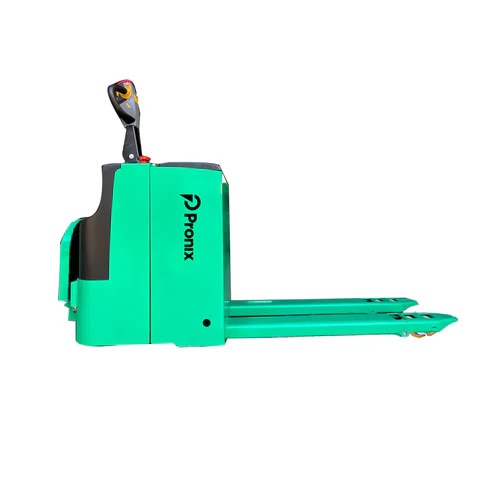 | Material Handling Electric Pallet Truck 2 Ton Self Drive Pronix Electric Pallet Truck 2 Ton PNXEPT-20SD Specification: Brand - Pronix Model No. View product → |
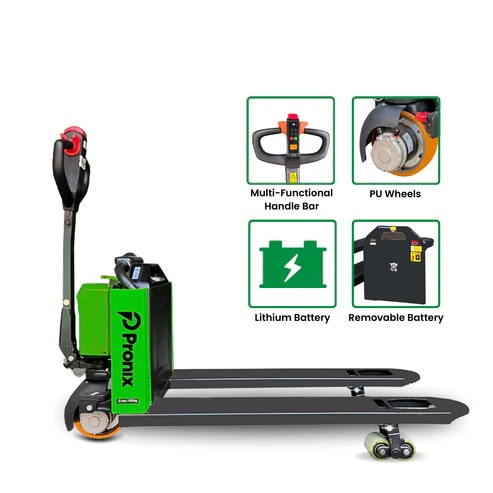 | Material Handling Pronix Electric Pallet Truck 1.5 Ton PNXEPT-15 Specification: Brand - Pronix Model No. View product → |
Frequently asked questions
Who may operate a battery pallet truck?
Only trained, authorised operators should use one. Walk-behind and rider versions are OSHA Class III powered industrial trucks, not Class I counterbalanced forklifts.
What should you inspect before operating a battery pallet truck?
Check the forks, wheels, controls, emergency stop, horn, battery condition, charger connection and visible hydraulic or electrical damage before moving a load.
How do you verify a pallet truck’s real load limit?
Read the truck’s capacity plate, identify the load centre, inspect the pallet and compare the complete load weight with the rated capacity at that load centre.
Should you choose a walkie or stand-up pallet truck?
Choose a walkie model for shorter travel and tighter spaces. Choose a stand-up rider model when operators cover longer distances and need greater travel efficiency.