

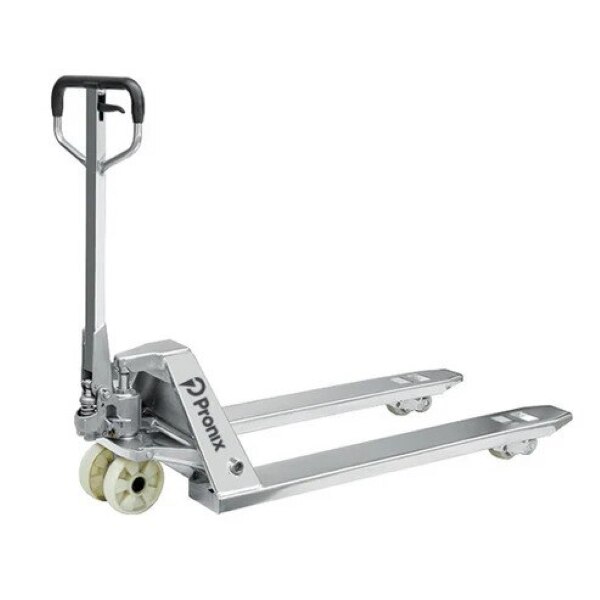
A manual hand pallet truck is safe only when its forks, load, wheels, route, and operator effort suit one another. By the end, you will be able to inspect a truck, judge whether a load is stable, measure your route, and specify a model that can be controlled without relying on its headline capacity alone.
Key takeaways
- Inspect forks, wheels, handle, hydraulics, and brakes before use.
- Keep the load centred, stable, and below the truck’s rated capacity.
- Match fork length and width to the pallet openings and route.
- Confirm floor condition, gradients, clearance, and wheel suitability before buying.
How do you operate a manual hand pallet truck safely?
Operate a manual hand pallet truck safely by inspecting it, loading it correctly, and travelling with the forks low.
1. Complete a pre-use inspection. Check the steering handle, tiller return, pivot hardware, forks, welds, frame, steering wheels, load rollers, wheel bearings, hydraulic leaks, hydraulic pump action, lowering control, and legible capacity marking. Remove the truck from service if it leaks, lowers under load, pumps inconsistently, or has bent or cracked forks.
Repair it before use.
2. Approach the pallet squarely and insert both forks fully. Confirm that the fork tips will not strike the opposite pallet board, rack, truck bed, or load. Centre the load across both forks, then pump only enough to clear the floor. Do not lift higher for routine travel.
3. Lower the load before moving. Keep hands and feet away from wheels, fork heels, pivot points, and other pinch points. Maintain visibility; if the load blocks your view, travel in the direction that keeps the route visible or use a spotter.
Move at a controlled walking pace and push rather than pull where the route allows.
4. Treat standard hydraulic forks as a transport lift, not a work platform. Never stand on the forks or use them to support a person. High-lift and scissor trucks require separate controls for raised-load travel, stability, pinch points, and personnel exposure. A working hydraulic pump does not make an elevated load safe for people.
How do you decide whether a load is stable and within usable capacity?
A rating plate is only the starting point: rated capacity assumes the manufacturer’s specified load centre, balanced weight, full fork engagement, sound equipment, and a suitable floor. Safe usable capacity is lower whenever those assumptions fail.
Before lifting, assess the actual load centre, weight distribution, pallet condition, fork engagement, and truck condition. Secure or repack uneven loads, loose cartons, tall stacks, and liquid containers whose contents can shift. Replace pallets with broken boards; a damaged base can collapse even below the marked capacity.
If the load’s centre of gravity extends beyond the specified load centre, it can exceed the truck’s usable capacity while its total weight remains below the rating. Partial fork entry, a sloping floor, damaged pallet boards, or unusual starting and stopping forces reduce control further.
| Truck choice | What can go wrong | Decision |
|---|---|---|
| 2.5-ton truck | A light but unstable or poorly supported load can tip, shift, or become impossible to steer | Reject it unless the load is secured and controllable |
| 3-ton truck | Extra headline capacity does not correct an off-centre load, partial entry, or damaged pallet | Verify load stability and usable capacity |
| 5-ton truck | Greater rating can add truck mass and push effort without making an uncontrolled load safe | Do not select it as a substitute for securing or repacking |
Test the actual route before movement. You must start, stop, steer, and change direction by hand; if a slope or stopping force defeats control, do not move the load with that truck.
How do you match fork dimensions to the pallet and route?
Measure the pallet and route before comparing truck capacity. Record these site dimensions, then match each against the truck specification:
- Pallet length and width; entry-side clearance; opening height; rack or truck-bed height
- Pallet underside obstructions, blocked or offset entry points, and the tightest turning point
- Aisle width, doorway clearance, and steepest gradient
- Fork length, single-fork width, overall fork width, minimum fork-entry height, lift height, turning envelope, and maximum load weight
Two-way pallets accept forks only from their two open sides; four-way pallets offer entry from all four sides, but their blocks can still restrict fork width or depth. Narrow pallets need a matching overall fork width, while closed-bottom pallets can reject standard forks altogether.
Forks must enter deeply enough to support the load without striking the opposite board, rack, truck bed, or cartons.
| Pallet or truck type | Compatibility check | Main risk |
|---|---|---|
| Low-profile truck | Reaches unusually low openings; verify minimum fork height | Less ground clearance makes thresholds and rough floors hazardous |
| Standard-height truck | Suits ordinary openings and offers more clearance | May fail to enter a low pallet fully |
| Narrow or offset-entry pallet | Match fork spacing and entry location exactly | Partial engagement can leave the load unstable |
| Closed-bottom pallet | Confirm fork access beneath the deck | Forks may not enter at all |
Give the supplier this checklist against your actual pallet fleet, route measurements, and heaviest load. Reject a specification that confirms only nominal capacity but not fork length, entry height, turning envelope, and clearance.
Can the floor, wheels, and route support manual movement?
A truck is suitable only if you can move and control it on the actual route, not merely lift the load. Check that aisles are clean, level, unobstructed, adequately lit, and wide enough for turning.
Inspect floor joints, thresholds, potholes, broken concrete, oil contamination, and the steepest gradient; these conditions increase starting, stopping, steering, and pulling effort.
OSHA 1910.22 requires clean, orderly walking-working surfaces maintained against hazards, while 1910.176 requires material-handling aisles to provide safe clearance and remain clear. A 30 mm ground clearance describes the space beneath one truck component; it does not make the truck suitable for potholes, rough concrete, thresholds, or steep ramps.
Wheel choice changes both control and operator effort:
| Wheel or roller | Strength | Limitation |
|---|---|---|
| nylon wheels | Roll easily on smooth hard floors | Transmit impact and noise |
| polyurethane wheels | Reduce noise, marking, and impact | Demand more effort on rough or contaminated floors |
| tandem load rollers | Cross small joints and pallet-board transitions better | Add resistance, parts, and maintenance complexity |
Wheel wear, an off-centre load, a gradient, and a high threshold each raise push or pull force. Prefer pushing where the route allows, but assess actual starting force, frequency, posture, and stopping distance. Repeated ramp work is a poor application: a freely rolling load can overpower the operator during starting, stopping, or direction changes.
redesign the route instead of relying on strength or a parking brake.
What should you include in a hand-pallet procurement and service specification?
Write the specification around the measured application, not the truck’s largest capacity rating. Record:
- Maximum load weight, load centre, pallet types, fork length and width, minimum entry height, lift range, and strokes to lift.
- Turning envelope, doorway and aisle clearances, floor condition, washdown requirements, and the route’s maximum gradient.
- Wheel material, wheel compound, roller arrangement, and the starting, stopping, and turning effort expected on that route.
| Application | Specify | Why it matters |
|---|---|---|
| Food or washdown | Exposed fastener and bearing materials, seals, drainage, hydraulic-fluid compatibility, and approved cleaning chemicals | Water ingress and aggressive cleaners can destroy bearings and hydraulic components behind a “stainless” frame |
| Chemical service | Fluid compatibility, seal material, drainage, and wheel compound | Spills can swell seals, attack wheels, or contaminate hydraulic fluid |
| Outdoor work | Fastener and bearing protection, wheel compound, drainage, and surface limits | Rain, grit, thresholds, and uneven concrete change control and service life |
Name the pallet’s two-way or four-way entry, blocked underside, and low opening; a low-profile truck can enter lower openings but loses ground clearance. Specify tandem or single rollers, then test the turning envelope against the tightest aisle.
Use ISO 3691-5 for pedestrian-propelled pallet-truck safety. Do not substitute OSHA 29 CFR 1910.178, which covers powered industrial trucks, for a conventional manual truck; OSHA 1910.22 and OSHA 1910.176 still govern workplace surfaces, aisles, storage, and material handling.
SS Quality Air Solutions can check dimensions against your route and provide hand pallet truck service when a leak, damaged wheel, or faulty lowering valve appears.
Related products
 | Material Handling Pronix Hand Pallet Truck 2.5 Ton With Fork Length 1150x550mm PNXPT-25 Specification: Brand - Pronix Type - Hand Pallet Truck Model No. View product → |
 | Material Handling Pronix Hand Pallet Truck 3 Ton PNXPT30 Specification: Brand - Pronix Type - Hand Pallet Truck Model No. View product → |
Frequently asked questions
How do you operate a manual hand pallet truck safely?
Inspect the truck before use, centre the load on both forks, keep the forks low while travelling, and pull rather than push when visibility or control requires it. Keep people clear of the route and never ride on the truck.
How do you decide whether a load is stable and within usable capacity?
Check the truck’s rated capacity plate, load centre, pallet condition, and weight distribution. Reject leaning, damaged, overhanging, or unsecured loads, and leave capacity margin for uneven floors and movement.
How do you match fork dimensions to the pallet and route?
Measure pallet entry openings, overall width, length, and underside clearance. Select forks that enter fully without contacting the pallet, then confirm the truck fits aisles, doorways, turns, ramps, and loading points.
Can the floor, wheels, and route support manual movement?
Check for potholes, expansion joints, loose debris, oil, standing water, slopes, and tight turns. Choose wheel materials and sizes that suit the floor, and verify that the operator can move the loaded truck without excessive force.
What should you include in a hand-pallet procurement and service specification?
Specify rated capacity, load centre, fork dimensions, lift height, steering angle, wheel material, turning radius, operating environment, inspection points, spare parts, warranty, and response times for repairs.
Related products
 | Material Handling Pronix Hand Pallet Truck 5 Ton With Fork Length 1210x685mm PNXPT-50 Specification: Brand - Pronix Type - Hand Pallet Truck Model No. View product → |
 | Material Handling Stainless Steel Hand Pallet Truck 2.5 Pronix Stainless Steel Hand Pallet Truck 2.5 Ton with Fork Length 1150x550mm PNXPT-25SS Specification: Brand - Pronix Type - Hand Pallet Truck Model... View product → |