

The right compressor is sized from measured airflow, required point-of-use pressure, operating hours, and air quality—not from connected motor horsepower alone. By the end, you can compare compressor technologies, calculate a realistic capacity range, account for system losses, and test supplier performance data against your factory’s actual demand.
Key takeaways
- Size from measured CFM or litres per minute and actual duty cycles.
- Add point-of-use pressure losses before choosing discharge pressure.
- Match compressor technology, storage, and controls to demand patterns.
- Compare supplier test data, piping design, service support, and lifecycle risk.
Calculate Airflow From Real Demand, Not Connected Horsepower
Start with air compressor sizing from measured demand, not connected horsepower. Record each tool or machine in CFM or litres per minute, then apply its actual duty cycle instead of adding every nameplate figure at full load.
| Demand item | What to record | How to use it |
|---|---|---|
| Base load | Minimum flow, operating hours, pressure band | Covers steady CNC, packaging, or instrumentation demand |
| Peak load | Highest simultaneous CFM or litres per minute | Sets required compressor capacity |
| Intermittent devices | Run time, cycle frequency, and duty cycle | A tool running 20 seconds each minute uses about one-third of its rated flow |
| Leakage and blow-off | Non-production-hour leakage and open-nozzle demand | Add measured losses, then challenge blow-off with engineered nozzles or mechanical alternatives |
| Expansion | Defined future machines and their expected flow | Add a documented allowance, not an arbitrary percentage |
Use a flow meter or compressor data logger while the plant operates. Compare average flow, peak flow, minimum flow, and operating hours with the connected tools and machines; estimates alone can hide a large base load.
For a 3–40 HP installation, compare required flow with delivered FAD at the specified pressure and inlet conditions, not the horsepower label.
Convert CFM and litres per minute consistently, and mark every figure as actual, standard, or free-air volume before comparing suppliers. Select capacity from the peak profile, then check unloaded running.
An oversized compressor can consume substantial power while producing little useful air; a centrifugal model also needs operation above its minimum stable-flow limit to avoid surge, recycle, or blow-off losses.
Set Discharge Pressure After Calculating Point-of-Use Losses
Set compressor discharge pressure from the most demanding machine backward: required point-of-use pressure plus the pressure drop through the aftercooler, dryer, filters, regulators, valves, hoses, and piping. State the target as pressure in bar, with pressure in psi for teams using imperial specifications.
| Location | What the gauge proves | What it cannot prove |
|---|---|---|
| Compressor discharge | Pressure leaving the package | That downstream equipment receives its set pressure |
| Receiver or header | Stored or distributed system pressure | That a spray gun, CNC actuator, packaging valve, or instrument has adequate point-of-use pressure |
| Point of use | Pressure available at the tool or machine inlet | That the compressor has enough capacity during peak flow |
Check every component’s pressure-drop curve at actual flow, inlet pressure, temperature, and contaminant loading. A filter’s clean initial rating is not its lifetime pressure drop: a blocked element can waste energy and reduce point-of-use pressure. Specify differential-pressure monitoring and an element replacement limit.
Do not raise header pressure to hide an undersized filter or badly designed branch. Higher pressure increases leakage and artificial demand.
Choose a refrigerated dryer when a positive pressure dew point meets the application. Specify a desiccant dryer when subzero pressure dew point is required. Define the ISO 8573-1 class for oil, particles, and water; “clean air” is not a specification. Class 0 does not mean zero oil.
Require the stated concentration, test conditions, and measurement method, including total oil in liquid, aerosol, and vapour forms.
Choose the Compressor Technology and Compression Stages
Match the compressor to the demand pattern, not the connected motor horsepower. A reciprocating compressor suits intermittent demand, workshops, smaller factories, and tools that draw air in cycles with receiver storage between uses.
A rotary screw compressor is usually better for continuous plant air, while a rotary vane compressor fits steady industrial duty when its maintenance schedule and service support suit the site.
| Option | Best fit | Main caution |
|---|---|---|
| Reciprocating compressor | Intermittent tools, workshops, smaller factories | Noise, pulsation, and wear increase with long continuous duty |
| Rotary screw compressor | Continuous or high-hour plant air | An oversized unit can run unloaded and waste power |
| Rotary vane compressor | Steady industrial operation | Confirm vane life, service access, and local support |
| Scroll compressor | Low vibration or oil-free air | Check capacity limits and expansion in stages |
| Centrifugal compressor | High flow with stable demand | Stay above minimum stable flow; surge oscillates, while blow-off or recycle wastes power |
Single-stage reciprocating compression suits lower pressure requirements and uses one compression step. Two-stage compression divides the pressure rise, and intercooling lowers discharge temperature and improves efficiency at higher pressures; it also adds cylinders, valves, coolers, and maintenance points. Compare pressure, temperature, noise, oil policy, service access, and operating hours.
A variable-speed drive helps when demand varies across a substantial share of operating time, not when a compressor runs steadily at full load. Check the manufacturer’s lowest stable operating range, control method, and performance at your actual demand profile before choosing VSD.
Match Storage, Controls, and Capacity to Intermittent or Continuous Use
A receiver covers a short peak; it does not repair an undersized compressor. Separate the steady base load from bursts, then match compressor FAD, receiver volume, and controls to the measured demand profile.
1. Identify the base load and peak duration. A packaging line, instrumentation network, or continuous production system needs a compressor that sustains its average and peak flow. Pneumatic tools, clamping circuits, and occasional spray painting create intermittent demand that storage can cover briefly.
2. Complete receiver tank sizing from required flow, allowable pressure swing, compressor control mode, and peak duration. A larger receiver can stabilise pressure and reduce short cycling, but it cannot sustain demand that exceeds compressor output.
Match the receiver to start-stop, load-unload, or variable-speed controls so the compressor does not repeatedly start or remain unloaded for long periods.
3. Test the complete application before selecting a 3–40 HP machine. Intermittent workshop tools may suit this range, while a continuously operating CNC cell, spray booth, packaging line, or process-air header needs a measured FAD review before choosing a piston compressor.
4. Add named future machines to the demand profile, with their expected flow and operating schedule. Do not add an undocumented capacity percentage.
5. Check inlet temperature, altitude, cooling-water temperature, and room ventilation. Hot or thin inlet air reduces mass flow; poor ventilation raises compressor, motor, dryer, and control temperatures, causing thermal unloading or trips.
Compare Supplier Data, Distribution Design, and Total Operating Risk
Approve a compressor package only after comparing delivered free air delivery (FAD) at your calculated operating point, specified discharge pressure, and actual inlet conditions. Reject comparisons based on piston displacement, swept volume, or an unexplained nominal SCFM figure.
| Data to request | What to verify | Why it matters |
|---|---|---|
| FAD | Rated flow at operating pressure and inlet temperature | Shows usable capacity |
| ISO 1217 | Test basis and acceptance method | Makes supplier figures comparable |
| Power input | Motor and package power at the operating point | Exposes energy cost |
| Controls | Load/unload, variable-speed, or modulation range | Predicts unloaded running and stability |
| Pressure | Working range, not only maximum pressure | Prevents excess header pressure |
Review the complete package: receiver, aftercooler, dryer, filters, automatic drains, controls, safety devices, and service intervals. Confirm each pressure drop at the actual flow; raising header pressure to overcome a blocked filter increases leakage and artificial demand.
A looped or ring main generally limits pressure variation better than a long single-ended header. Slope compressed-air piping toward low-point drains, and take branches from the top where possible so condensate stays out of point-of-use lines.
Challenge open blow-off, cooling, and sweeping as major loads. Compare engineered nozzles, air amplifiers, lower-pressure blow-off, and mechanical alternatives; OSHA 29 CFR 1910.242(b) requires cleaning nozzles below 30 psi unless specified safeguards are provided.
SS Quality Air Solutions can support a measured comparison of packages, piping, and air compressor repair and service. Approve the supplier that documents delivered performance and post-commissioning support, not the one listing the highest horsepower.
Related product
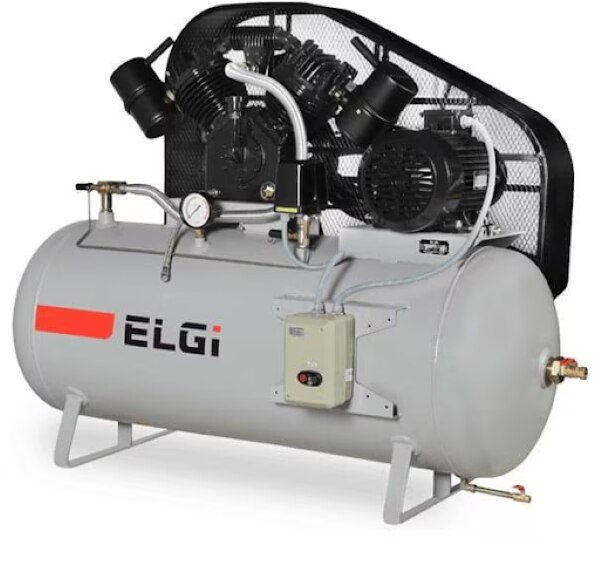
 | Reciprocating Compressors 3-40 HP SINGLE AND TWO STAGE INDUSTRIAL PISTON COMPRESSORS WHY ELGi's BELT-DRIVEN AIR COMPRESSOR? Robust cast iron air compressor with high durability The belt-driven air compressors from ELGi are made of... View product → |
Frequently asked questions
How do you calculate industrial air compressor capacity?
Record each tool or machine’s air demand in CFM or litres per minute, then multiply by its actual duty cycle instead of adding every nameplate value at full load. Include simultaneous demand, leakage, future capacity, and a suitable operating margin.
How do you choose the correct compressor discharge pressure?
Start with the pressure required at the point of use, then add pressure losses through filters, dryers, regulators, hoses, piping, valves, and fittings. Do not raise compressor pressure to compensate for undersized or poorly designed distribution piping.
Which compressor technology is best for industrial applications?
Choose reciprocating, rotary screw, or another technology according to airflow, operating hours, duty cycle, required pressure, air quality, noise, maintenance access, and energy priorities. Use two-stage compression when the required pressure and efficiency justify its added equipment and maintenance.
How much air storage does an industrial compressor system need?
Size storage around the demand pattern rather than using a fixed tank rule. Intermittent loads need receiver capacity to cover short peaks and reduce compressor cycling, while continuous loads require capacity control and compressor output that closely matches sustained demand.
What should you compare when selecting an air compressor supplier?
Compare tested airflow and power data at the stated pressure, compressor controls, dryer and filtration options, distribution design, installation requirements, spare-parts access, repair response, maintenance scope, and total operating risk.