

A 3,000 kg truck is not automatically a 3,000 kg solution: mast height, load centre, attachments, aisle geometry and battery weight can change what it safely lifts. By checking those conditions against your warehouse, you can choose the right truck class, charging arrangement and operating-cost model instead of relying on a catalogue capacity alone.
Key takeaways
- Rate the forklift against the heaviest complete load and its actual load centre.
- Check truck dimensions against aisle width, rack depth, turning space and door clearances.
- Match battery capacity, charger output and charging-room ventilation to each shift pattern.
- Compare energy, maintenance, downtime and service responsibility before choosing a supplier.
Start with the load, not the 3,000 kg number
A 1,850 kg pallet is not automatically safe for a 3,000 kg electric forklift. Weigh the heaviest complete load, measure its length and height, locate its centre of gravity, and record any uneven or shifting contents.
The key figure is the load centre distance: the horizontal distance from the fork face to the load’s centre of gravity.
Check the truck’s capacity plate for your exact mast, lift height and attachment. Confirm:
- Maximum load weight and load centre distance
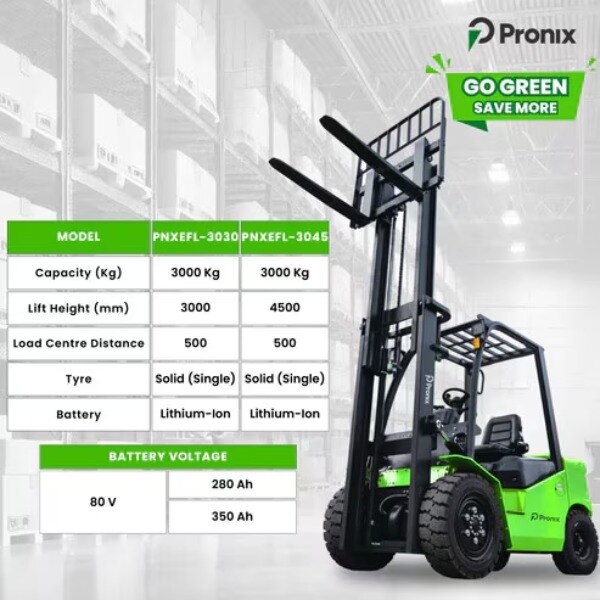
- Capacity at 3,000 mm and 4,500 mm lift heights
- Fork, clamp, rotator or other attachment weight
- Pallet dimensions, fork-pocket spacing and load overhang
- Required residual capacity after the load is raised and moved
Rated capacity is conditional, not a permanent 3,000 kg allowance. A plate might show 3,000 kg at a specified load centre and low lift height, but a longer load, higher mast position or heavy attachment reduces residual capacity. Use the plate value for the actual configuration, not the truck’s headline rating.
Do not retrofit a lighter lithium-ion battery without approval. Battery mass helps counterbalance the load; changing its weight, dimensions or centre of gravity can invalidate stability assumptions. If the attachment or truck is modified, obtain manufacturer or qualified-engineer approval and revised capacity markings before operation.
Reject the specification if the required residual capacity is absent at the highest lift and worst-case load centre.
Translate the truck dimensions into a workable warehouse layout
Before choosing a 3,000 mm or 4,500 mm mast, measure the complete travel path with the largest load fitted—not an empty aisle. The truck’s published Ast aisle width is the controlling figure; a generic forklift aisle width can leave no turning room.
1. Record clear aisle width between permanent obstructions, then measure the turning bay at each aisle end. Include column guards, fire equipment, door jambs and the load’s front overhang. Compare these dimensions with the selected model’s Ast aisle width and turning radius for your actual load centre.
2. Measure rack beam height, upright projection and every obstruction above the route. Keep rack clearance around the load, not merely the fork tips; a 4,500 mm mast can reach higher while striking sprinklers, lights, beams or the next rack, and its raised load can restrict forward visibility.
3. Measure door height and width, dock-plate width and rated capacity, ramp gradient, threshold height, lift-gate openings and ceiling height. Check the truck’s overhead guard and mast in both lowered and raised positions.
4. Confirm floor load limits and slab condition along aisles, docks and charging areas. Mark uneven joints, drains and slopes because they affect stability and clearance.
Ask for dimensional drawings and Ast values for the exact mast, fork length, attachment and load. Recheck the layout with the mast fully raised before ordering.
Choose the right electric truck for the movement and storage task
Choose a counterbalanced electric forklift when you need one truck to pick pallets from the floor, load or unload vehicles, cross dock plates, and place loads into moderate-height storage without tailpipe exhaust. Its forks project ahead of the truck, so it handles varied pallet sizes better than a reach truck.
| Truck | Best fit | Wrong choice when |
|---|---|---|
| Class I electric rider truck | Indoor pallet loading, unloading, transport, and general warehouse work | Long outdoor shifts, rough ground, standing water, or charging downtime exceeds the operating plan |
| Internal-combustion forklift | Ventilated yards, ramps, rough surfaces, and continuous heavy-duty work | Exhaust, fuel storage, noise, or indoor air quality is unacceptable |
| Class II electric narrow-aisle truck or electric reach stacker | High rack storage where the truck’s specified Ast aisle width and reach geometry fit | You need frequent dock work, long travel, or stable handling of oversized loads outside the rack |
| Class III electric hand truck | Floor-level pallet movement over short, repeatable routes | You must stack, retrieve from racks, travel long distances, or protect the operator from heavy pushing |
| Hand pallet truck | Occasional movement on smooth, level floors | Throughput, travel distance, slopes, or load frequency makes manual handling slow or unsafe |
Select the counterbalanced truck when access to several work areas matters more than maximum rack density. Keep the electric reach stacker for storage lanes designed around its reach, mast, turning geometry, and load centre; substituting it for a counterbalanced truck can leave docks and open-floor tasks inefficient.
Include pedestrian separation and speed controls: a quiet electric truck is not automatically a visible one.
Specify the battery, charger and charging room as one system
Treat the battery, charger and room as one system. Size charger capacity from the truck’s voltage, battery ampere-hours or kilowatt-hours, shift energy use, and the time available for charging—not from forklift capacity alone. Confirm the connector, communication protocol and charging profile match the battery and truck.
Battery choice changes the building and the work pattern.
| Battery type | Selection and operating consequence |
|---|---|
| Lithium-ion forklift battery | Suits multi-shift work and approved opportunity charging without routine watering. Specify discharge and charge temperature limits; charging below the manufacturer’s limit can cause lithium plating and permanent damage. |
| Flooded lead-acid battery | Costs less to replace in some operations but loses available capacity in cold conditions, needs watering and cooling time, and releases hydrogen while charging. Provide ventilation and ignition control; hydrogen is flammable in air from about 4% to 75% by volume. |
Before approval, check these controls:
- Match the battery’s mass, dimensions, centre of gravity, connector and restraint to the truck. A lighter lithium-ion pack is not a safe retrofit if it changes stability or rated capacity.
- Put the battery charging area away from traffic, sparks and combustible storage. Provide ventilation sized to prevent hydrogen accumulation for lead-acid charging.
- Use the manufacturer-approved charger, BMS communication and temperature protection. Never bypass a fault code or charge a damaged, wet or impact-struck pack.
- Keep lead-acid batteries upright, inspect electrolyte levels, and allow cooling before the next charge. Permit lithium-ion opportunity charging only when the battery and charger are designed for it.
Calculate the full operating cost and service responsibility
A low electricity bill does not make an electric forklift economical. Calculate purchase or lease cost, electricity, battery and charger life, tyres, labour, downtime, inspections, training, repairs and resale value across the planned service life.
Compare the exact truck class: a Class I rider truck is not a cost substitute for a Class II narrow-aisle truck or Class III pallet truck.
Price these operating items before approving the budget:
- Electricity consumed per shift, plus demand charges and charging losses.
- Battery replacement, charger testing, connector wear and charging-room ventilation.
- Forklift maintenance for forks, mast chains, hydraulics, tyres, steering, brakes, lights and warning devices.
- Lost production while the truck waits for parts or a technician.
- Operator training, workplace evaluation and paid time away from normal duties.
Examine each truck daily before use, or after every shift in round-the-clock operation. OSHA training requires formal instruction, practical training and workplace evaluation; repeat evaluation at least every three years and after an accident, near miss, unsafe operation, truck change or workplace change.
Lead-acid charging also needs ventilation and ignition control because hydrogen is flammable from about 4% to 75% in air.
| Support model | Cost advantage | Responsibility and risk |
|---|---|---|
| In-house | Lower contract spend | You stock parts, train technicians and manage records |
| Supplier contract | Predictable forklift service cost | Confirm response time, preventive-maintenance intervals and loan-truck terms |
| Mixed | Critical work is covered | Define who handles daily checks, batteries and breakdown escalation |
Ask SS Quality Air Solutions to put those responsibilities, parts availability and service response times in writing before comparing quotations.
Related products
 | Fork Lift Electric Forklift 3.0Ton Capacity 4.5m Specifications: Brand - Pronix Type - Electric Forklift Model No. View product → |
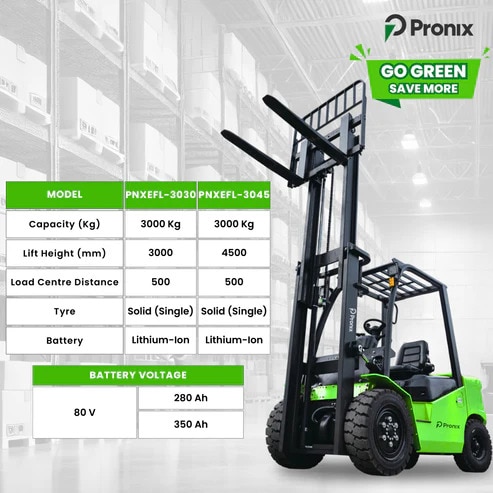 | Fork Lift Electric Forklift 3.0Ton Capacity 3.0m Pronix Electric Forklift 3.0Ton Capacity 3.0m Lifting Height PNXEFL3030 Specifications: Brand - Pronix Type - Electric Forklift Model No. View product → |
Frequently asked questions
Why is a 3,000 kg forklift not automatically safe for a 1,850 kg pallet?
Capacity depends on the complete load, load centre, height, length, stability and whether contents shift. Weigh and measure the heaviest load before selecting the truck.
Which warehouse dimensions must you check before choosing an electric forklift?
Check truck length and width, turning radius, aisle width, rack depth, door height and width, floor condition, loading clearances and pedestrian routes.
How do you choose the right electric forklift for the movement and storage task?
Match the truck type, mast height, attachment and rated capacity to the travel distance, pallet condition, rack configuration, floor surface and daily handling pattern.
What must be specified together with an electric forklift battery?
Specify battery chemistry and capacity, charger rating, charging time, duty cycle, charging-room layout, ventilation, electrical supply and the plan for battery service.