

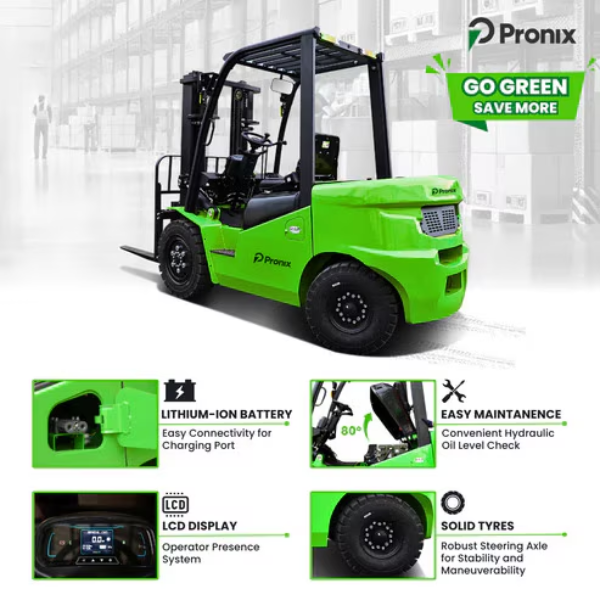
Selecting a Fork lift requires more than checking how much weight a machine can lift. The same load may be easy to handle in a spacious outdoor yard but difficult inside a narrow warehouse aisle. Lift height, load centre, floor condition, operating hours, aisle width, and working environment all influence equipment suitability.
For industrial operations in Delhi-NCR, evaluating these factors before purchase can prevent a machine from becoming poorly matched to daily work.
Begin With the Load
Identify what the forklift will actually handle.
Record typical load weights, maximum expected weight, pallet dimensions, load shape, and load stability. Unusual or oversized loads may require additional assessment.
Capacity should be considered in relation to the complete operating configuration rather than treated as a single isolated number.
Measure Required Lift Height
A forklift that primarily loads goods at floor level has different requirements from equipment used for warehouse racking.
Measure the highest level at which goods need to be placed or retrieved. Also examine available overhead clearance, doorways, structural beams, and other height restrictions along the operating route.
Check the Working Space
Turning space can determine whether a particular machine is practical.
Measure aisle widths, corners, loading areas, rack spacing, entrances, and staging zones. A machine that performs well in an open yard may be inconvenient in a compact storage facility.
The warehouse layout should therefore be evaluated before equipment specifications are finalised.
Consider Indoor Conditions
Indoor material handling raises additional questions.
Ventilation, noise, floor condition, charging arrangements for electric equipment, operating duration, and pedestrian movement all deserve attention.
Outdoor applications may involve uneven surfaces, weather exposure, gradients, or longer travel distances.
Equipment selection should reflect where the machine spends most of its operating time.
Compare Usage Intensity
Occasional material movement places different demands on equipment from continuous multi-shift operation.
Ask how many hours the forklift is expected to operate each day. Consider peak dispatch periods and whether production depends heavily on uninterrupted material movement.
Higher utilisation can make service planning and equipment availability particularly important.
Evaluate Operator Visibility
Operators need appropriate visibility when approaching racks, loads, doorways, intersections, and pedestrians.
Load dimensions can sometimes obstruct forward visibility. Warehouse layout, lighting, mirrors, markings, and operating procedures can therefore be just as important as equipment selection.
Think About Maintenance Access
A forklift becomes part of the facility's operating infrastructure.
Before selection, consider routine maintenance requirements, service accessibility, parts availability, tyre condition monitoring, battery requirements where applicable, and the facility's maintenance practices.
SS Quality Air Solutions supports industrial businesses evaluating material-handling equipment according to practical site requirements.
A useful forklift selection process starts on the warehouse floor, not in a product catalogue. Measuring loads, racks, aisles, travel distances, lift heights, operating hours, and site conditions creates a clearer equipment specification.
That approach helps businesses choose material-handling equipment according to the work it must perform every day rather than relying only on headline capacity.