

A compressed-air system can show no visible water at the compressor and still deliver moisture that damages instruments, spoils paint, or causes condensation in outdoor lines. You will be able to specify the required pressure dew point, size the dryer from real operating conditions, protect its desiccant, and compare purge and energy costs before selecting equipment.
Key takeaways
- Specify pressure dew point at the operating pressure.
- Size the dryer using peak flow, inlet temperature, and pressure.
- Protect desiccant beds with filtration and correct regeneration settings.
- Compare purge-air losses, energy, maintenance, and replacement media costs.
Define dry air with pressure dew point, not a vague quality claim
Specify high-quality dry compressed air by its pressure dew point, or PDP, at a stated operating pressure. Ambient relative humidity, or the difference between pressure dew point and atmospheric dew point, is not enough to specify compressed air moisture levels.
A positive atmospheric dew point does not tell you whether water will condense after the air travels through a cold pipe.
For example, a −40 °C PDP is measured while the air remains at its operating pressure; expansion downstream changes the moisture relationship. Select the requirement from the coldest point in the system and the process risk.
| ISO 8573-1 water class | Maximum pressure dew point |
|---|---|
| Class 1 | −70 °C |
| Class 2 | −40 °C |
| Class 3 | −20 °C |
| Class 4 | +3 °C |
| Class 5 | +7 °C |
| Class 6 | +10 °C |
Use about +3 °C for a warm indoor plant only when no colder section can cause condensation. Choose −20 °C for pneumatic controls or lines entering cooler areas, −40 °C for outdoor distribution, painting, and demanding instrumentation, and approximately −70 °C for critical pharmaceutical, food-packaging, laboratory, or product-contact applications needing extremely dry air.
Ask the dryer supplier to state whether the quoted PDP applies at:
- Full rated flow
- Specified inlet pressure
- The stated outlet measurement point
A PDP number without those conditions is incomplete.
Understand how each dryer technology removes and restores moisture
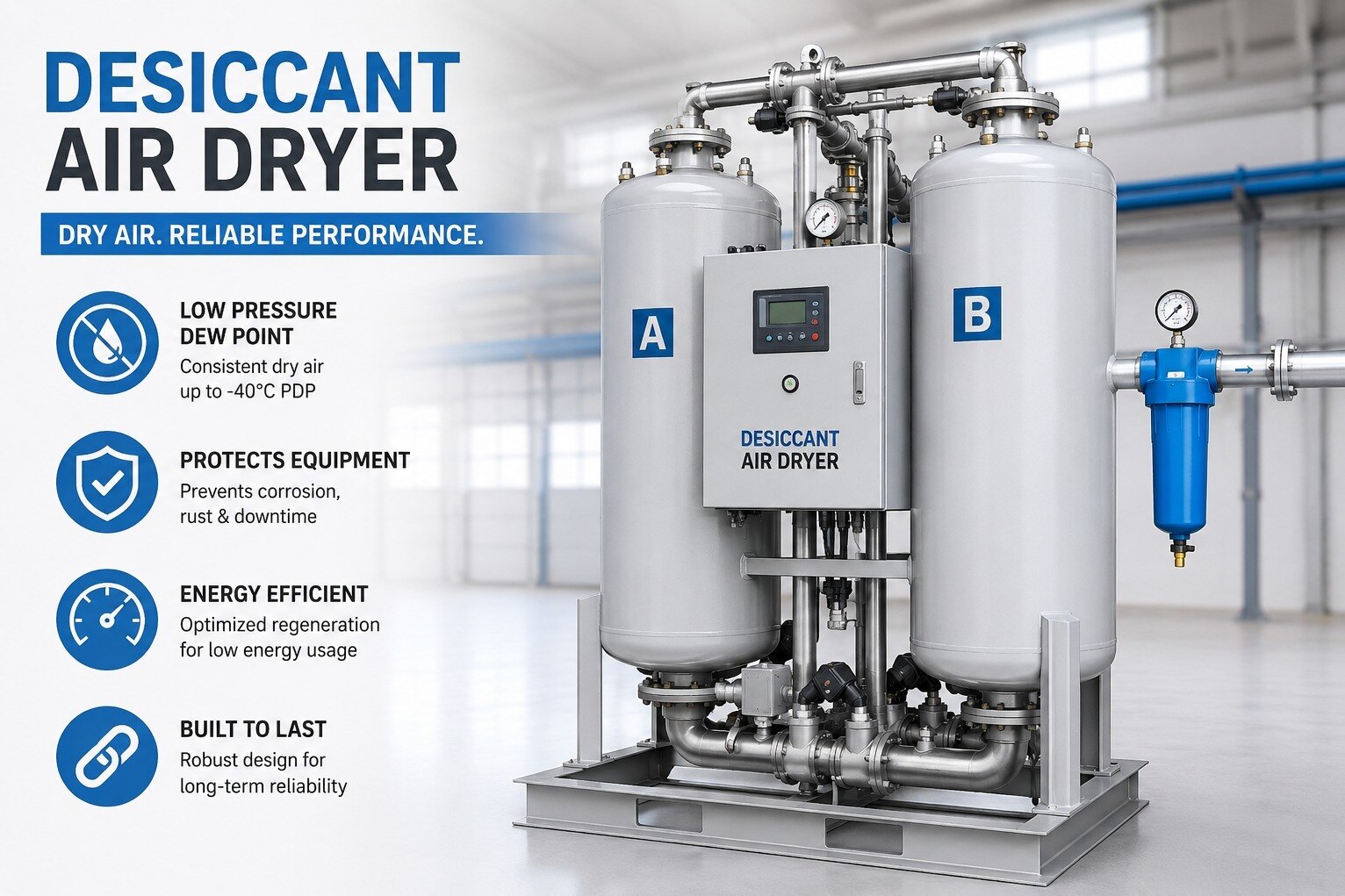
Water vapour sticks to the surface of a solid desiccant such as activated alumina, silica gel, or molecular sieve. As compressed air flows through the active bed, adsorption removes moisture and produces a low pressure dew point. The desiccant eventually fills with water, so it must be regenerated rather than replaced after every cycle.
A twin-tower heatless desiccant dryer alternates the work. One tower dries the plant air while the other releases captured moisture using a portion of the already dried outlet air. That purge stream commonly consumes 15–20% of inlet flow at rated conditions, reducing air available for production.
Switching valves, purge leaks, or insufficient regeneration time can create intermittent wet-air excursions, especially when the dew-point sensor sits immediately after the dryer.
| Technology | How moisture is restored or separated | What changes in operation |
|---|---|---|
| Heatless desiccant | Dry compressed-air purge strips moisture from the offline bed | Lower capital cost, but significant air loss |
| Heated-purge dryer | A heater warms regeneration air, reducing the purge requirement to roughly 5–10% | Lower air loss, with added heater energy and controls |
| Blower-purge dryer | A blower supplies regeneration air; a heater removes the captured moisture | Little or no compressed-air purge, but higher electrical use, cost, and footprint |
| Membrane dryer operation | Water vapour diffuses through selective hollow fibres and exits with a sweep stream | No desiccant bed or tower switching, but flow, pressure, and dryness capability are limited |
A −40 °C pressure dew point at dryer pressure describes that operating condition; expansion downstream changes the corresponding atmospheric dew point.
Size the dryer from real flow and inlet conditions
Start with actual maximum and average flow in Nm³/min or CFM, not compressor nameplate horsepower. Compressor horsepower is not a capacity rating: two compressors with the same motor size can deliver different airflows at different pressures.
Document these inputs before dryer sizing:
| Operating data | Why it matters | What to provide |
|---|---|---|
| Maximum and average flow | Sets bed loading and cycling | Peak and normal Nm³/min or CFM |
| Inlet pressure and temperature | Changes air mass and water load | Pressure, compressor discharge temperature, and inlet temperature |
| Required pressure dew point | Determines adsorption duty | Required pressure dew point at operating pressure |
| Site conditions | Affect correction factors | Ambient temperature and altitude |
| Regeneration conditions | Determine usable capacity and purge loss | Purge flow, cycle time, heating, and blower conditions |
Apply the manufacturer’s correction tables for every variable, including the inlet pressure correction factor. A nominal rating at 7 bar(g), 35 °C inlet air, sea-level altitude, and −40 °C PDP cannot transfer directly to a higher-temperature, lower-pressure installation.
Lower inlet pressure reduces the mass of air a bed can process; higher inlet temperature raises the water load.
Size for corrected peak demand, including leaks, future expansion, blow-off valves, and intermittent high-flow equipment. Heatless units commonly consume about 15–20% of inlet flow for purge regeneration, so include that loss in the air balance.
Ask for corrected inlet flow, outlet pressure, pressure drop, and guaranteed PDP rather than accepting a model selected from horsepower alone. Install an aftercooler, moisture separator, and automatic drain before the dryer. A failed drain sends condensate into the bed and overwhelms even a correctly rated dryer.
Protect the desiccant bed and verify performance through maintenance
A failed automatic drain can send liquid water into the bed, while a saturated coalescing element allows oil carryover to reach the desiccant. Hot, saturated compressor discharge increases the water load; even an oil-free compressor still needs filtration because liquid droplets, rust and pipe scale can damage adsorption material.
1. Inspect the liquid water separator and automatic drain at each service visit. Confirm that condensate discharges under load; a blocked drain leaves liquid water upstream of the dryer.
2. Check the upstream coalescing filter, also called the coalescing pre-filter, for differential pressure and oil staining. Replace a saturated element promptly. Oil can coat the desiccant surface, reduce capacity, increase pressure drop and resist removal during regeneration.
3. Confirm that the aftercooler reduces discharge temperature before the separator. Sending hot air directly to the bed can produce saturated desiccant before the scheduled maintenance interval.
4. Inspect the downstream particulate filter, or particulate after-filter, for rising differential pressure and desiccant dust. New or disturbed media release dust that can enter valves, instruments and product-contact lines.
5. Trend outlet pressure dew point with a dew-point monitor. Alarm on deterioration during start-up, demand peaks, prolonged shutdowns or faulty tower switching; do not rely only on a fixed timer.
6. Compare both towers’ switching times, valve operation and regeneration flow. A tower that fails to regenerate can deliver wet air before the next cycle completes.
Compare lifecycle cost before choosing the dryer arrangement
Compare total annual cost, not the dryer’s purchase price: electricity, lost air, pressure drop, replacement filters, regeneration power, maintenance, and the cost of protecting only part of the plant.
| Option | Main lifecycle cost | Best fit and limitation |
|---|---|---|
| Desiccant, heatless | Purge-air consumption plus bed, valve, and filter pressure drop | Low dew points; air loss calculation matters |
| Desiccant, heated or blower-purge | Heater and control power; blower systems cost more and occupy more space | Reduce purge; compare regeneration power with heatless simplicity |
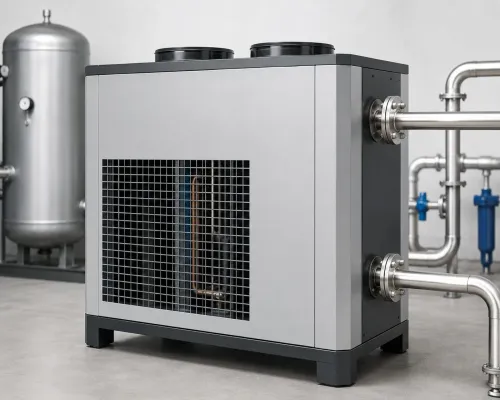
| Refrigerated | Compressor power and condensate management, with little air loss | Warm indoor applications; unsuitable where the required PDP is below incoming air conditions |
| Membrane | Continuous purge or sweep-air loss and element replacement | Compact point-of-use protection; expensive for high flow |
| Coalescing filter | Element replacement and pressure drop | Removes oil and liquid aerosols, but does not replace a dryer when the required PDP is below incoming air condition |
| Point-of-use dryer | Multiple small units, service, and uneven plant protection | Protects selected tools or instruments rather than the distribution system |
Heatless dryer purge consumption is commonly 15–20% of inlet flow at rated conditions. If it processes 10 Nm³/min and consumes 20% purge, about 2 Nm³/min is unavailable, so the compressor must supply roughly 12 Nm³/min before other losses.
Multiply purge flow by operating hours and the compressor’s specific energy consumption to estimate the annual energy burden. Heated-purge systems commonly reduce purge to roughly 5–10%; blower-purge dryers use little or no compressed-air purge but add a blower and heater.
Include bed, valve, filter, and piping pressure drop: every additional bar increases compressor work and the compressor energy bill. SS Quality Air Solutions can support a site survey, capacity check, piping review, or service plan. Ask for corrected flow, PDP, purge percentage, pressure drop, filter replacements, and regeneration power in writing.
Frequently asked questions
What is the correct way to specify dry compressed air?
Specify the pressure dew point, or PDP, at a stated operating pressure. Ambient relative humidity does not define moisture content inside a compressed-air system.
How do desiccant air dryers remove moisture?
A desiccant bed adsorbs water vapour from compressed air. Twin-tower designs regenerate the saturated bed with purge air, heated air, or a blower while the second bed dries the air.
What information is needed to size a desiccant air dryer?
Use actual and peak compressed-air flow, inlet pressure, inlet temperature, required PDP, ambient conditions, and the dryer’s pressure-drop and correction-factor data.
How do you protect and verify a desiccant dryer?
Install suitable upstream filtration, prevent liquid water entering the bed, follow the regeneration cycle, replace exhausted desiccant, and verify PDP with a calibrated dew-point instrument.
Which costs belong in a desiccant dryer lifecycle comparison?
Compare purchase price, purge-air or heater energy, pressure drop, filter replacement, desiccant replacement, controls, servicing, and production losses during maintenance.