

Liquid water reaches downstream equipment when a dryer is selected by compressor horsepower, installed before effective separation, or operated with a failed drain. You will be able to match the dryer to real operating conditions, specify its pressure dew point, install it correctly, and keep moisture from becoming a production fault.
Key takeaways
- Match dryer capacity to inlet airflow, pressure, temperature, and pressure dew point.
- Use an automatic drain that removes condensate without wasting compressed air.
- Install prefilters, afterfilters, isolation valves, and bypass piping for service.
- Check dryer performance at peak heat, pressure, and compressor loading conditions.
How a Refrigerated Dryer Controls Moisture
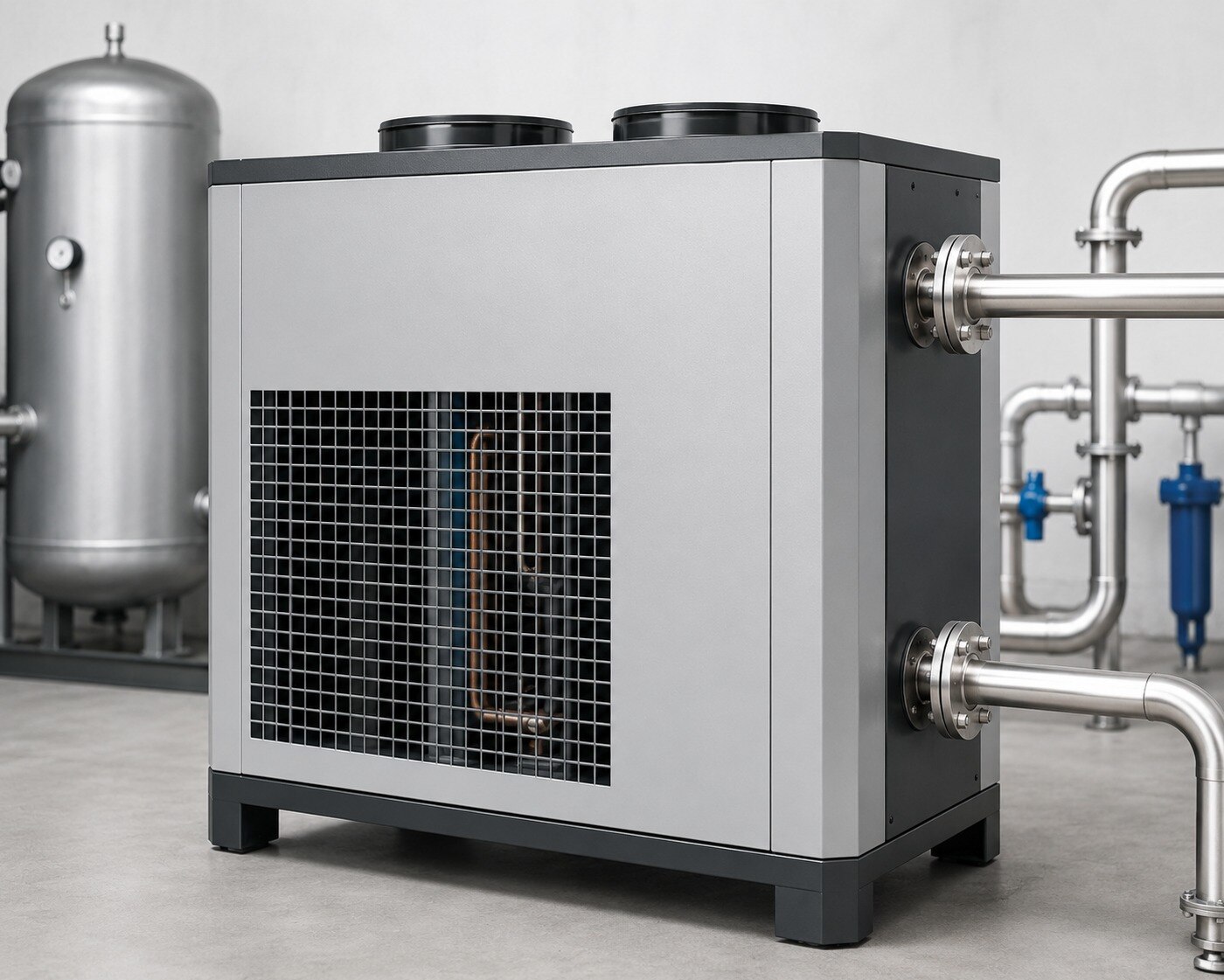
Wet compressed air becomes suitable for ordinary plant distribution when it is cooled below its pressure dew point, allowing water vapour to condense and drain away. The refrigerated air dryer working principle uses an air-to-air heat exchanger and a refrigeration circuit to remove that moisture without drying the air to desiccant levels.
- Incoming compressed air passes through the air-to-air heat exchanger, where returning cool outlet air precools it and reduces the refrigeration load.
- The refrigeration circuit cools the air further until water vapour becomes liquid.
- A moisture separator captures the liquid water.
- An automatic condensate drain discharges the collected water, while the outgoing dry air reheats through the heat exchanger.
A standard refrigerated dryer commonly targets about +3°C pressure dew point. That figure is not the same as outlet temperature: pressure dew point is the temperature at which condensation begins at the compressed-air pressure. Compare the rating with the pressure at the point needing condensation protection; expansion changes the measured dew point.
Sub-zero protection requires a desiccant dryer.
The dryer removes condensed water, not every oil or particle contaminant. Add the specified coalescing or particulate filtration when air cleanliness matters. Keep the condenser clean and ventilation clear, because heat, dust, or restricted airflow can raise condensing pressure, trip the refrigeration circuit, and cause the dryer to miss its pressure dew point.
A bypass also sends wet air directly downstream unless positively isolated.
Choose Capacity by Airflow and Pressure Dew Point
Size the dryer from actual free air delivery, not compressor horsepower. Record the maximum combined flow in m³/min or CFM, then check that figure against the manufacturer’s rating after applying dryer correction factors for inlet pressure, inlet-air temperature, and ambient or cooling-water temperature.
Use these figures for refrigerated dryer sizing:
- Maximum free air delivery, including compressors that may run together
- Minimum operating pressure at the dryer inlet
- Maximum compressed-air inlet temperature
- Maximum ambient-air or cooling-water temperature
- Required pressure dew point
- Permitted pressure drop and connection size
Pressure dew point is the moisture limit at the compressed-air pressure where protection matters. Do not compare it with an atmospheric dew-point reading: expansion changes the reading. A standard refrigerated dryer usually targets about +3 °C, broadly matching ISO 8573-1 water Class 4.
If your specification calls for −20 °C, −40 °C, or −70 °C, choose a desiccant dryer instead.
| Selection | What happens | Check |
|---|---|---|
| Undersized | Flow restriction, rising pressure drop, and wet downstream air during peak demand | Corrected capacity exceeds maximum flow |
| Correctly sized | Rated performance remains available at worst operating conditions | Use the manufacturer’s correction chart |
| Oversized | Higher purchase and operating cost without a drier outlet | Avoid sizing from an inflated future estimate |
Select against the worst combination, not the daily average. Leave useful capacity for peak flow, but do not pay for a nominal rating that applies only at cooler, higher-pressure test conditions.
Build the Dryer into the Compressed-Air System
Put the dryer downstream of the compressor’s aftercooler, liquid separator, and wet receiver. This compressed air dryer installation lets hot air cool and bulk water collect before refrigeration, reducing the dryer’s thermal and liquid load.
Keep the dryer in a clean, ventilated room with clearance around its condenser and heat exchangers. Dust on an air-cooled condenser, restricted exhaust air, high room temperature, or inadequate cooling-water flow raises condensing pressure, trips the refrigeration circuit, and causes the specified pressure dew point to be missed.
Use this arrangement as the piping baseline:
- Install a working automatic drain on the aftercooler separator, wet receiver, dryer separator, and dry receiver. A failed-open timed drain wastes air; a failed-closed drain carries accumulated water downstream. A zero-loss demand drain avoids routine air loss but still needs inspection and cleaning.
- Fit the filtration required for the air quality: a particulate or coalescing filter for oil and solids, plus activated carbon when oil vapour removal is specified. The dryer does not remove these contaminants.
- Place a dry receiver downstream when short demand peaks need stored dry air. Size and drain it; storage does not correct an undersized dryer.
- Provide a bypass only for maintenance. Use positively isolating valves, a controlled restart, and a bypass-open indicator or interlock where wet air could damage production.
- Compare pressure dew point at the operating pressure where condensation protection is needed, not against an atmospheric dew-point reading.
| Location | Main benefit | Required protection |
|---|---|---|
| Before dryer | Cooling and liquid storage | Aftercooler, separator, drain |
| After dryer | Short peak support | Dry receiver and drain |
| Bypass line | Maintenance access | Locked isolation and status indication |
Treat Drains, Filters, and Condensate as Reliability Equipment
An automatic drain is a reliability component, not a minor accessory: a failed-closed drain lets liquid rise into downstream filters and piping, while a failed-open drain wastes compressed air continuously.
| Timed drain | Opens at set intervals | Simple systems where air loss is acceptable |
|---|---|---|
| Float drain | Opens when collected liquid lifts the float | Basic separation with regular cleaning and inspection |
| Zero-loss drain | Opens only when liquid reaches its demand point | Systems that must prevent routine compressed-air loss |
Select the drain for the separator’s liquid load, then install an isolation valve, strainer, and test function. A zero-loss drain avoids the normal operating-air loss of a timed drain, but dirt can stop its sensor or valve from closing.
Use a particulate filter to catch rust and solid debris, and a coalescing filter to remove liquid water and oil aerosol that the dryer does not remove. If oil vapour matters, add an activated-carbon stage; filtration does not eliminate the need to specify the required air-quality class.
Treat condensate from an oil-lubricated compressor as contaminated waste. An oil-water separator, hydrocarbon measurement, and approved disposal route depend on the compressor oil and local rules; the dryer drain is not environmental treatment.
Protect drains, regulators, and low points from freezing. A +3 °C pressure dew point offers little margin in an unheated area below the dryer’s operating limit, so trace heating, insulation, or a lower-dew-point dryer may be necessary.
Specify the Dryer for Real Operating Conditions
Specify performance at the worst operating condition, not at the compressor’s nominal horsepower. Require the supplier to state flow in m³/min or CFM, inlet pressure, maximum inlet temperature, ambient or cooling-water temperature, and the correction factors used.
| Design | Energy and control | Best fit |
|---|---|---|
| non-cycling refrigerated dryer | Runs refrigeration continuously; simpler, but uses more power at low load | Steady demand with limited load variation |
| cycling refrigerated dryer | Stores cooling effect and reduces refrigeration runtime | Sites with large changes in airflow or shift-based production |
Write the pressure dew point at the pressure where protection is needed. A standard refrigerated dryer targets about +3 °C; specify a desiccant dryer for −20 °C, −40 °C, or −70 °C requirements. Do not compare the rating with an atmospheric dew-point reading.
Your purchase specification should state:
- Maximum allowable pressure drop through the dryer and clean filters, because added resistance can force higher compressor discharge pressure.
- Air-cooled or water-cooled condenser requirements, including room temperature, ventilation clearance, and cooling-water flow.
- Automatic drain type, fail-open and fail-closed alarms, and maintenance access.
- Separate particulate, coalescing, or activated-carbon filtration when oil vapour, aerosol, or particles matter.
- Voltage, connection size, bypass arrangement, and test conditions for the guaranteed PDP.
Ask SS Quality Air Solutions to verify these figures during industrial air compressor service, especially after filter loading and condenser fouling are considered.
Frequently asked questions
How does a refrigerated air dryer remove moisture?
It cools compressed air below its pressure dew point, condenses water vapour, and drains the liquid before reheating the air.
How do you choose refrigerated dryer capacity?
Compare the dryer’s rated airflow with your peak demand after adjusting for inlet temperature, ambient temperature, operating pressure, and the specified pressure dew point.
Where should a refrigerated dryer be installed?
Install it downstream of the air receiver or aftercooler, with suitable filtration, isolation valves, a service bypass, and drainage access.
Why do drains and filters affect dryer reliability?
Blocked drains allow liquid carryover, while overloaded or poorly maintained filters restrict flow and increase pressure loss.