

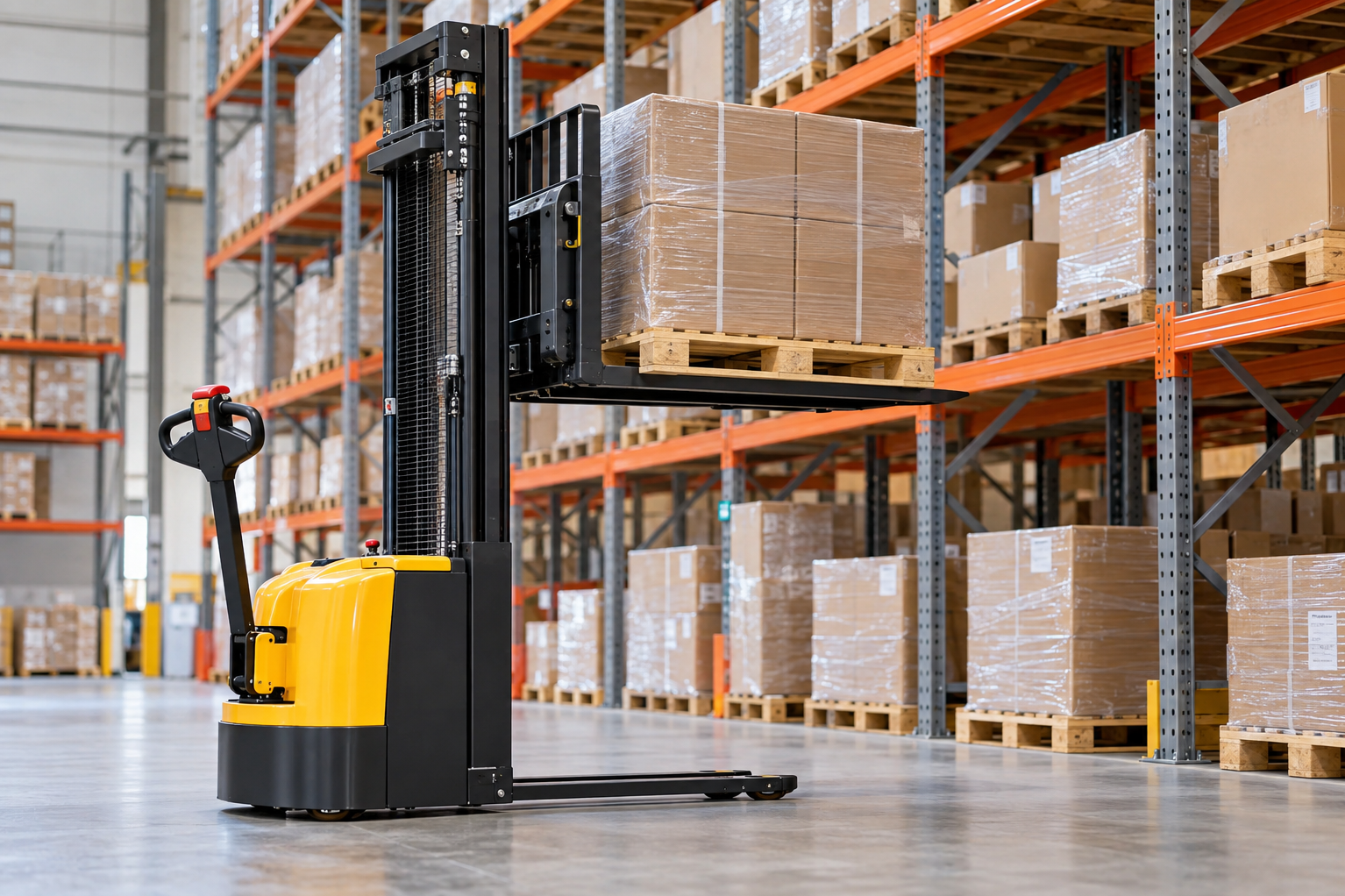
Warehouses do not always need a conventional forklift for every pallet movement. When the primary requirement is lifting, positioning, or stacking palletised loads within a relatively defined area, a stacker may provide a suitable material-handling solution.
For industrial facilities in Haridwar, Uttarakhand, stacker selection should begin with the warehouse layout and workload rather than equipment appearance or capacity alone.
Identify the Required Lift Height
The first measurement is straightforward: how high must the load travel?
Record the height of each relevant rack level and consider clearance requirements. The selected machine must be suitable for the intended lifting height under the specified load conditions.
Do not assume that maximum lifting capacity remains identical at every configuration or height. Manufacturer specifications should be checked carefully.
Measure Pallets Properly
Pallet dimensions affect fork compatibility and load positioning.
Determine pallet length, width, entry configuration, and typical load placement. If the facility uses several pallet types, each common format should be considered.
Poor compatibility can slow material handling and create unnecessary operational difficulties.
Study the Aisle Layout
Stackers are often considered where efficient use of warehouse space is important.
Measure working aisle width, turning zones, rack entrances, columns, doorways, and staging areas. Also consider whether operators regularly encounter pedestrians or other material-handling equipment.
A machine should fit the real route, not merely the storage bay.
Match Capacity to Actual Loads
Never estimate pallet weight visually.
Document the typical and maximum load weights handled by the facility. Where products vary considerably, warehouse teams should establish clear load information.
Capacity selection should include an appropriate understanding of the machine's technical ratings and operating configuration.
Consider Daily Usage
A stacker used several times per day has a different operating profile from equipment used repeatedly throughout a full shift.
Higher movement frequency may influence whether manual, semi-powered, or fully powered equipment is appropriate.
Travel distance matters as well. A warehouse with long internal routes may require a different material-handling approach from one where pallets move only short distances.
Check Floor Conditions
Stable material movement depends on the operating surface.
Inspect floors for cracks, uneven joints, slopes, debris, or transitions between different surfaces. These conditions can influence equipment operation and should be considered during site assessment.
Plan for Safe Use
Material-handling equipment should be incorporated into the facility's safety procedures.
Operators need appropriate training for the equipment they use. Loads should remain stable, rated capacities should be respected, and travel routes should be managed carefully.
SS Quality Air Solutions can support businesses evaluating stacker requirements according to warehouse layout, load characteristics, and operating frequency.
A stacker is most useful when its purpose is clearly defined. Rather than buying equipment first and adapting the warehouse later, facilities should measure their pallets, racks, aisles, loads, lift heights, and movement frequency.
Those measurements provide the practical foundation for selecting equipment that fits the workflow and supports more organised material movement.