
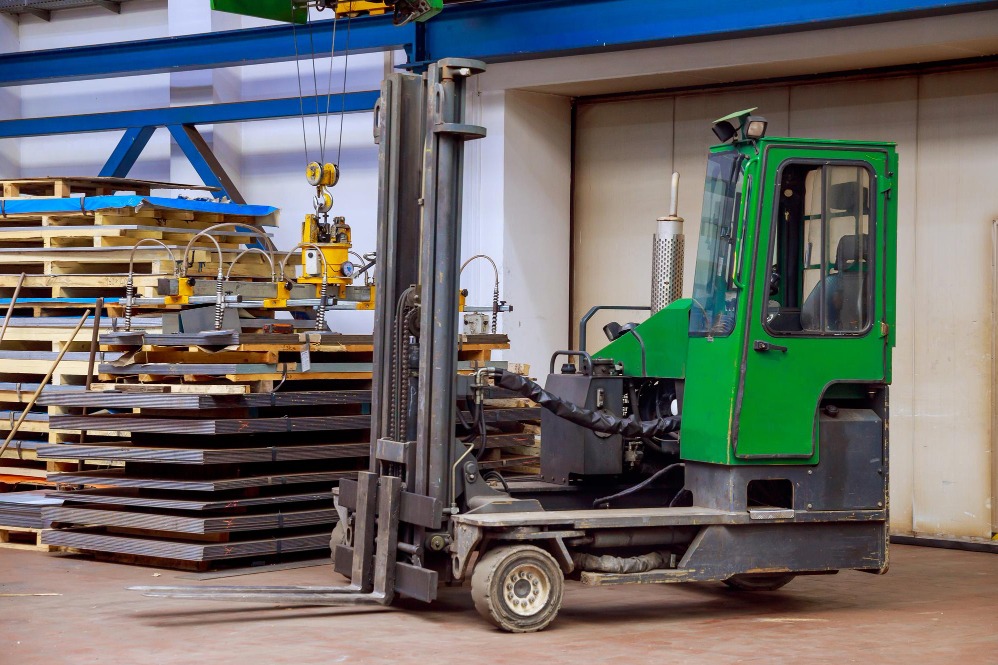
Choosing material-handling equipment becomes easier when the business first identifies exactly where manual work is creating limitations. A semi automatic stacker may be worth evaluating when pallet loads need controlled lifting but the facility does not necessarily require a larger powered forklift for every task.
For manufacturing units and warehouses in Muradabad, several operational signs can indicate that this type of stacker deserves consideration.
Pallets Need Regular Vertical Positioning
If employees frequently need to position palletised goods at raised levels, basic hand pallet equipment may no longer address the complete task.
A stacker is designed to provide vertical lifting capability in addition to material positioning. The required lift height should be measured against the facility's racks, platforms, and production requirements.
Your Handling Area Has Limited Space
Space can influence equipment choice significantly.
Factories sometimes have narrow internal storage zones, compact production areas, or limited manoeuvring space. In such conditions, equipment dimensions and turning requirements deserve close attention.
A site survey should record:
- Aisle width
- Door dimensions
- Turning areas
- Rack spacing
- Overhead clearance
- Floor condition
These measurements can quickly eliminate unsuitable options.
Loads Are Within a Predictable Range
A facility that handles relatively consistent pallet loads can define its equipment requirements more accurately.
Record typical weight rather than relying only on the heaviest load ever handled. Maximum expected weight still matters, but understanding everyday loads helps create a realistic operating profile.
Fork dimensions and pallet compatibility should also be verified.
Manual Lifting Processes Are Becoming Inefficient
Repeated material positioning can consume significant employee time when the available equipment does not match the job.
This does not automatically mean a semi-automatic machine is the correct answer. The facility should first map the process and identify where delays occur.
If the problem is horizontal movement over long distances, another equipment category may be more suitable. If vertical pallet positioning is the main challenge, a stacker becomes more relevant.
Usage Is Regular but Not Extremely Intensive
Operating frequency is an important readiness indicator.
Where pallet stacking occurs regularly but does not demand continuous high-throughput operation, a semi-powered solution may suit certain workflows.
For highly intensive operations, businesses may instead evaluate more extensively powered material-handling options.
Your Team Can Support Proper Equipment Practices
Equipment readiness includes people.
Operators should understand capacity limits, load stability, safe travel, parking procedures, pre-use checks, and site-specific hazards.
Maintenance responsibilities should also be clear.
You Have Defined the Requirement Before Requesting a Quote
A useful equipment enquiry should contain more than the words 'need stacker.'
Provide load weight, pallet dimensions, lift height, aisle width, usage frequency, travel distance, and floor conditions.
SS Quality Air Solutions can use these practical details when discussing equipment suitability for an industrial facility.
A semi-automatic stacker is worth considering when the warehouse has a clearly defined lifting requirement and the equipment matches the physical environment. Taking measurements before selection helps businesses avoid paying for unsuitable capacity or discovering operational restrictions after equipment reaches the site.