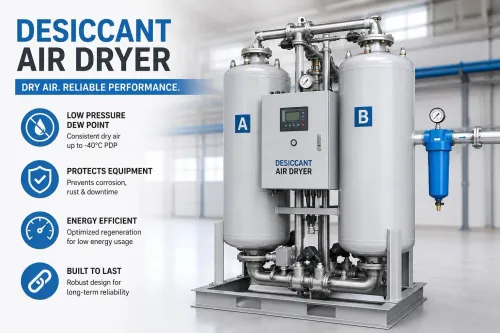
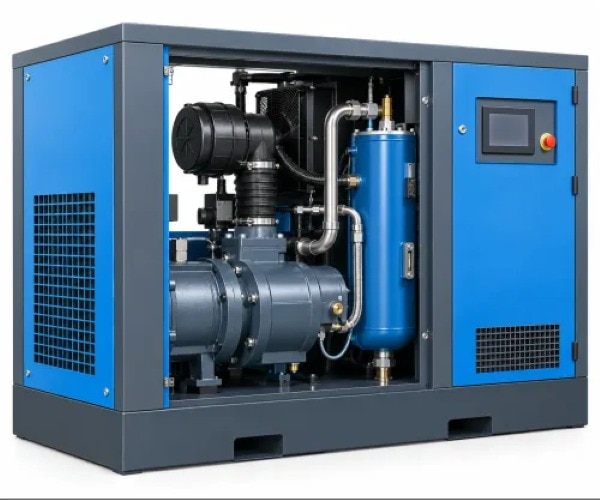
A high-demand plant needs more than a large motor: it needs stable airflow, correct pressure, controls that match changing demand and treatment equipment that preserves air quality. By the end, you will be able to compare screw and reciprocating compressors, calculate whether your demand justifies the change and specify a system without paying for unused capacity.
Key takeaways
- Measure peak flow, average demand and pressure before sizing the compressor.
- Use storage and variable-speed controls to manage changing air demand.
- Specify filtration, drying and room conditions with the compressor.
- Compare lifecycle cost, energy use, maintenance and installation—not nameplate capacity alone.
How rotary screw compression handles demanding production
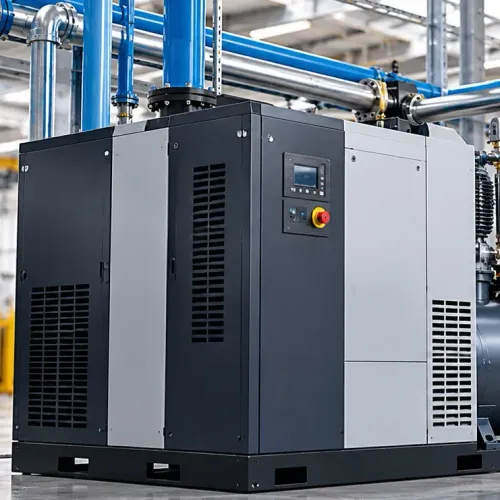
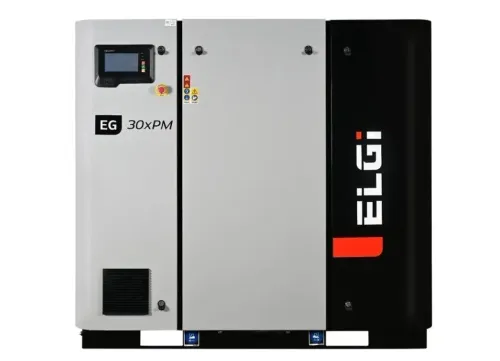
Rotary screw compression suits long, steady production because it delivers a near-continuous stream of air instead of the repeated fill-and-discharge pulses of a piston. Each rotor pair traps and reduces air volume as it turns, making the compressor a positive-displacement machine built for continuous duty.
| Dimension | Rotary screw compressor | Reciprocating piston compressor |
|---|---|---|
| Flow behaviour | Smooth delivery with low pulsation | Pulsed delivery; a receiver often absorbs pressure swings |
| Duty pattern | Suits long operating hours and high utilisation | Suits intermittent demand and lower operating hours |
| Pressure capability | Efficient for common plant pressures, such as 7–13 bar | Can reach higher pressures in suitable configurations |
| Noise and vibration | Lower pulsation, vibration and sound at comparable output | More mechanical movement, vibration and impact noise |
| Maintenance | Rotor and oil-system servicing at scheduled intervals | Valve, ring, cylinder and lubrication wear need closer attention |
| Purchase cost | Higher initial cost | Lower entry cost for smaller installations |
A duty cycle comparison with reciprocating compressors and piston compressors exposes the main trade-off: a piston unit may cost less to buy, but repeated cycling, heat build-up and wear make it a poor base-load choice for air consumed across every shift.
A screw compressor still needs correct sizing; pair a base-load machine with a trim compressor when demand changes, rather than leaving one oversized unit unloaded for hours.
Measure real demand before choosing compressor capacity
A screw compressor suits high demand when measured consumption stays substantial across operating hours per day and shifts, rather than appearing high because of a short peak. Record the shift pattern, required pressure in bar, and m³/minute flow rate at each production state before selecting capacity.
- Measure flow during normal production, cleaning, tool use and the highest-load shift; record both average and peak CFM.
- Add air used by dryers, filters, pneumatic conveyors and other connected equipment, then test the system for leakage with an ultrasonic survey.
- Separate genuine consumption from artificial demand, such as open blowing used to compensate for blocked nozzles or poor housekeeping.
- Size for peak FAD with operating margin, while documenting future expansion instead of buying excess capacity without a plan.
| Measure | What it means | How to compare |
|---|---|---|
| Free air delivery (FAD) | Air delivered at stated inlet conditions and pressure | Compare FAD at the same pressure and reference conditions under ISO 1217 |
| Advertised displacement | Theoretical swept volume of the compression element | Do not treat it as usable plant flow |
| Motor rating | Electrical input size | Do not use kW as compressor capacity |
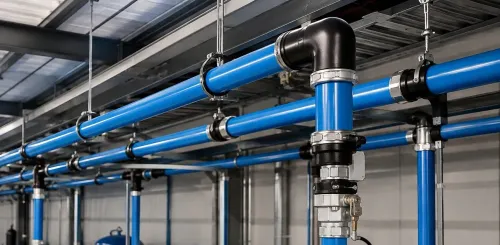
Check pressure drop through piping, separators, aftercoolers, dryers and filters at peak flow. Increasing discharge pressure to hide that restriction wastes power and increases leakage. An air receiver covers short peaks, not sustained demand; the compressor’s FAD must cover continuous use.
Match storage and controls to changing air demand
An air receiver tank covers short demand spikes; it does not increase compressor capacity. It stores compressed air, stabilises line pressure and prevents rapid loading and unloading, but sustained flow still depends on compressor free-air delivery and adequately sized piping.
Choose control strategy from the demand profile:
- A fixed-speed screw compressor using load-unload control suits steady demand near its rated output. During unloading, it still draws roughly 15–35% unloaded power consumption, so an oversized machine wastes energy while producing no air.
- A variable-speed drive VSD compressor reduces motor speed as demand falls. Check the manufacturer’s turndown range: below its minimum speed, the unit may unload, cycle or stop, limiting savings when demand stays near full load.
- Compressor sequencing matches several machines to changing demand. A base-load machine runs efficiently for the continuous requirement, while a trim compressor follows fluctuations; additional units remain available as standby capacity during maintenance or failure.
Use sequencing when demand varies enough to leave one large compressor unloaded for long periods. The controller must stage machines without excessive pressure swings, and the receiver must be large enough to absorb short peaks without forcing another compressor to start.
Do not raise discharge pressure to hide dirty filters, undersized piping or inadequate point-of-use storage. Higher pressure increases power use and leakage; correcting the restriction usually improves delivered air more effectively. Verify each compressor’s control response, minimum stable speed and sequencing logic under the plant’s shift-by-shift demand pattern.
Select air quality, treatment and room conditions together
Choose the oil configuration and treatment train from the process air-quality class, not from the compressor label. An oil-injected screw compressor uses oil for sealing, cooling and lubrication, while an oil-free screw compressor keeps oil out of the compression chamber. Neither choice alone guarantees clean air.
| Option | Air-quality and operating implications | Supporting equipment and room conditions |
|---|---|---|
| Oil-injected screw compressor | Requires oil separation and oil-management controls; condensate can contain regulated oil | Aftercoolers, separators, dryers, coalescing filters, particulate filters, and an appropriately sized condensate separator |
| Oil-free screw compressor | Avoids chamber oil but still needs filtration and maintenance to achieve the specified class | Dryers, coalescing filters, particulate filters, aftercoolers and adequate ventilation heat rejection |
Write the requirement as ISO 8573-1 classes for particles, water and oil, and state whether the limit concerns total oil or liquid oil. Size dryers, coalescing filters, particulate filters, aftercoolers and separators for peak flow, inlet temperature, ambient conditions and design pressure. Excess treatment creates pressure drop; undersized treatment cannot deliver the specified air quality.
Provide ventilation sized for the compressor’s heat rejection. Route oil-bearing condensate to an approved condensate separator or treatment system, never automatically to a floor drain or storm system. Compare the complete package using free-air delivery at the same pressure and reference conditions, such as ISO 1217; motor size is not delivered capacity.
Compare the complete system, not the compressor nameplate
Do not approve a quotation until it shows delivered air, operating cost and installation requirements for the complete system. Compare free-air delivery (FAD) at the same inlet condition and discharge pressure, using ISO 1217 data; motor size or advertised displacement is not a capacity comparison.
| Comparison item | Record in the final comparison | Why it matters |
|---|---|---|
| Capacity and pressure | FAD, working pressure, peak pressure and reference conditions | Excess pressure increases power use, leakage and pressure drop |
| System equipment | Compressor controls, sequencing, receivers, dryers, filters, separators and aftercoolers | Treatment equipment can restrict flow and needs sizing for peak demand |
| Distribution and demand | Piping diameter, pressure drop, leaks and end uses | A receiver stores short peaks but cannot cover sustained demand |
| Operating cost | Power at actual load, maintenance intervals, consumables and expected service life | Purchase cost alone can hide the largest ownership cost |
| Installation | Footprint, ventilation, noise, electrical supply and access for maintenance | A machine that fits the specification can still fail at the site |
Ask the supplier specification to state oil-injected or oil-free design, FAD test conditions, sound level, service clearances and warranty exclusions. SS Quality Air Solutions can help you check whether the quoted compressor, piping and treatment train match the measured demand rather than the nameplate.
Include a like-for-like commercial schedule showing:
- Purchase cost, freight, installation and commissioning
- Annual energy at your shift pattern and pressure
- Planned maintenance, replacement filters, oil and dryer servicing
- Controls and sequencing compatibility with existing compressors
- Cost of correcting leaks, undersized piping or local peak demand
A larger compressor with a lower rated motor efficiency can deliver worse whole-system efficiency when it unloads excessively or runs above the pressure your end uses require.
Frequently asked questions
Why are rotary screw compressors suitable for demanding production?
They provide a near-continuous air stream for long, steady production instead of the repeated pulses produced by piston compressors.
How do you measure demand before choosing compressor capacity?
Record average and peak flow, operating pressure, production schedules and leakage before selecting capacity.
How should storage and controls match changing air demand?
Size receivers and controls around demand changes, using storage to absorb short peaks and variable-speed control for fluctuating load.
What air quality and room conditions should you specify?
Choose filtration, drying and oil-control requirements with the application, while providing suitable ventilation, temperature control and clean installation conditions.
What should you compare beyond the compressor nameplate?
Compare delivered flow at operating pressure, energy consumption, maintenance, air treatment, storage, installation and lifecycle cost.